I run quality and compliance for a provider
Know every record will hold up before an auditor samples it.
Quality and compliance managers →Documentation compliance for NDIS, aged care and DVA providers. Every shift note, incident and care plan is checked against the participant’s plan and the standards before it is saved, and the evidence trail builds itself.
Built for
Standalone today. CRM connectors are in development →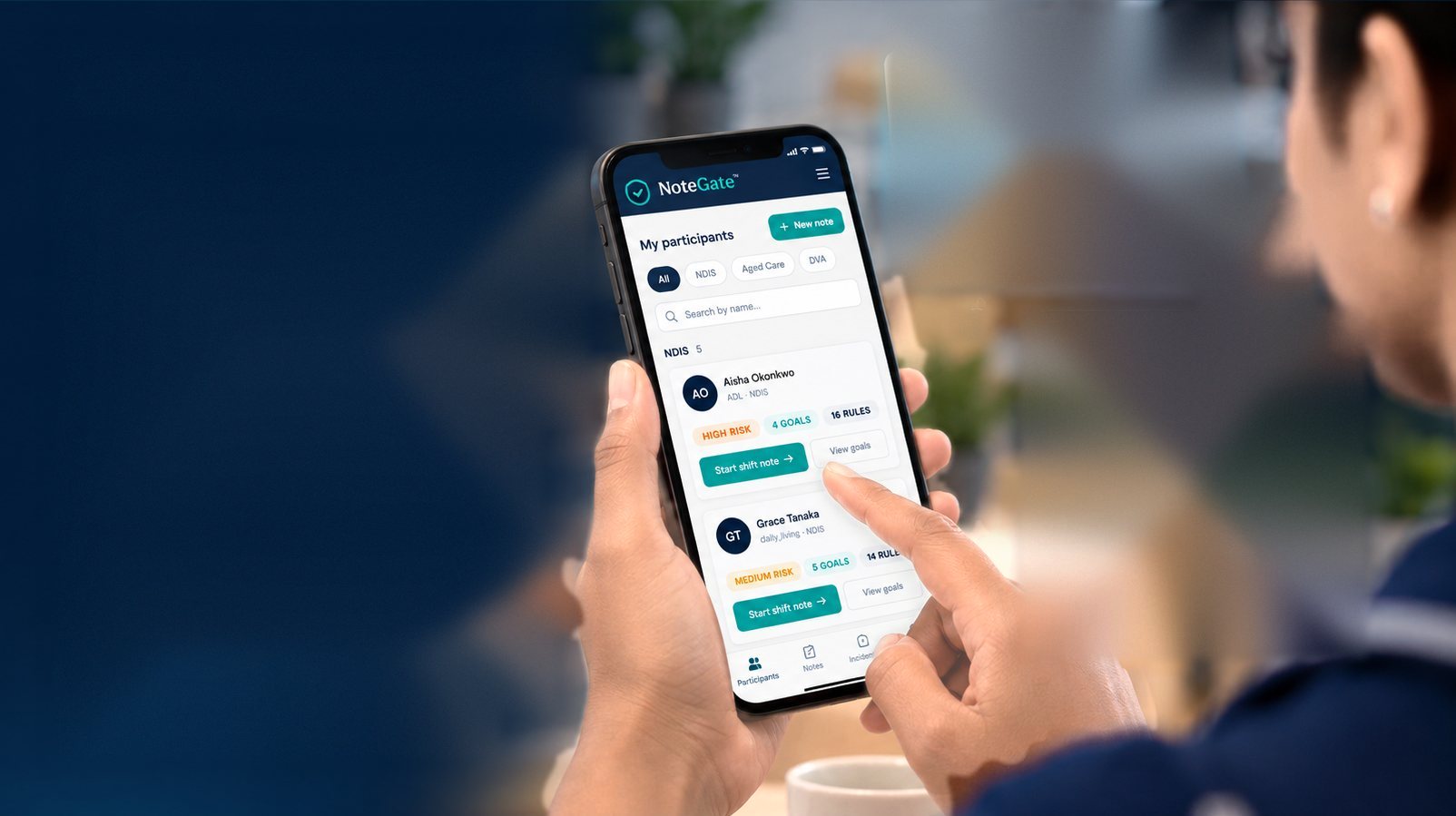
Know every record will hold up before an auditor samples it.
Quality and compliance managers →Records that show clinical reasoning, written on every shift.
Aged care →DVA community nursing →Your clients’ evidence, already built when you arrive.
Compliance consultants →Support coordinators →Running an NDIS provider? Read about NDIS compliance software.
Plans are uploaded, then left unreviewed after incidents, discharges, medication changes or new allied health advice. The document exists. It no longer reflects the person.
Falls, choking, behaviours and deterioration appear in documents without controls, evidence prompts or review dates. Documented risk without controls is still unmanaged risk.
No issues.
A note saying "no issues" does not evidence medication support, mealtime supervision, de-escalation or goal progress. The care plan says one thing. The shift note proves nothing.
Managers spend hours pulling plans, notes, incidents and reviews together because the evidence chain was never built as work happened. The audit pack should be a by-product of daily operation, not a crisis response.
Participant had a good day. No issues observed.”
NoteGate would have blocked it.
Every note is checked against the standards your auditor uses before it is saved. Incidents, risks and reviews link themselves to the participant as work happens, so the audit pack is a by-product, not a scramble.
Structured fields plus narrative, with mandatory prompts drawn from the participant's care plan and BSP.
[ID_01][LOC_02]Scored against the compliance criteria for the participant. Identifiers are tokenised before transmission.
Notes below the acceptance score return to the worker with precise corrections. High-risk participants route to supervisor review.
The accepted note goes to your system. The assessment, the corrections, the version history and the standards mapping stay in NoteGate, where an assessor can follow them.
The gap: a note that says "no issues" proves nothing at audit, and the gap is found months later. NoteGate checks each note against the participant's own criteria before it is saved and returns the exact fix to the worker.
Illustrative example. Not real participant data.
“Supported client in community. No issues.”
“14:00 to 16:30, Townsville Library. Supported participant to return books and use the self-checkout independently, per goal 2 (community participation). Participant completed checkout with one verbal prompt, down from three last week. No behaviours of concern. Next shift: practise selecting a book from the catalogue.”
As CEO, the documentation risk was mine to carry, and invisible until an audit. NoteGate closes the gaps before they form: every note meets the standard before it’s recorded, the evidence chain links itself as work happens, and anything missing reaches my team before a regulator can ask. My people decide every word. I finally know the records hold.
Hopesway is NoteGate’s founding customer and a related entity.
Shift notes are just the start. Six gates check the work and hold the proof, and Shift Primer keeps your staff current.
Three gates check the work.
Drafts and validates plans from referrals, NDIS plans and BSPs, for human review.
Scored against participant-specific criteria before it enters the record.
NDIS and SIRS reportability triage, corrective actions, language checks.
Three hold the proof.
Every identified risk has controls, review dates, escalation and prompts.
Flags expired or weak documents. Triggers review when needs or goals change.
Care plans, notes, incidents, risks and reviews in one trail, built as work happens.
Short good-practice refreshers for workers, on every plan.
The gap: care plans go stale after an incident, a discharge or a medication change, and nobody notices until an auditor asks. Plan Gate drafts and validates plan content from referrals, NDIS plans, BSPs and assessments, and generates participant-specific worker instructions, all for human review.
Book a 20-minute walkthrough →The gap: an incident report written from memory hours after the event misses the details a reportability decision depends on. NoteGate IRA captures the response at the point of submission: guided prompts, NDIS and SIRS reportability triage, and pre-submission checks.
Book a 20-minute walkthrough →The gap: a risk documented without controls, prompts or a review date is still an unmanaged risk. Risk & Compliance Intelligence keeps a live risk register, maps evidence to the Practice Standards and builds audit packs from your validated notes. Every signal reviewed by your staff.
Book a 20-minute walkthrough →The gap: pulling plan-review evidence together by hand takes hours and still leaves goal progress unproven. Supervisor reports and plan-review evidence assemble from validated notes into a lodgement-ready document: goal coverage, functional trends, incident risk summary.
Book a 20-minute walkthrough →The gap: the audit pack gets rebuilt in a rush because the evidence chain was never built as work happened. NoteGate keeps care plans, notes, incidents, risks and reviews in one trail and exports the pack in a click, so the evidence is ready when the assessor asks, not assembled the week before.
Short, participant-linked good-practice refreshers at the point of documentation build a continuous, audit-ready record of competency. Private to the worker, and it never blocks a note or an incident report.
NoteGate keeps the assessment and evidence trail in a record you control, separate from your billing and rostering.
Identifiers are tokenised before processing, data is stored only in AWS Sydney (ap-southeast-2), and it is never used for AI training. See Security and Data sovereignty.
NoteGate works standalone today: workers submit notes directly in NoteGate. Pre-built connectors for ten rostering and care-management platforms are in development, plus custom connections, and none is live yet.
How integration works →Providers delivering supported independent living now need to be registered under Group 0138 and prove in certification audits that participant-centred support is observable in practice, not just promised in policy. The question is no longer "Do you have a policy?" It is: can you prove your workers applied it in the participant's home?
Does your workforce management system translate into consistent, observable practice in the participant's home?
Can workers show they supported the participant's decision-making, will, and preference at the point of support?
The SIL Practice Standards module is audited at the provider’s next audit. Every shift note is part of the evidence trail.
Cost follows your caseload, not your headcount.
APP 8 cross-border obligations addressed through ZDR agreement and DeIDProxy tokenisation.
Protected NDIS information obligations enforced. NDIS Quality and Safeguards Commission standards supported.
Designed for use alongside Aged Care Quality and Safety Commission standards.
All data stored only on AWS ap-southeast-2 (Sydney). Region-deny S3 bucket policy enforced by architecture. No participant data ever leaves Australia. Verifiable on request.
NoteGate does not participate in service delivery. All final decisions remain with the provider.
No. NoteGate is a compliance check, not a writer. Workers write their own notes and reports. NoteGate validates them, scores them, and rejects anything below standard - the worker is always the author. This preserves legal accountability and defensibility under the NDIS Practice Standards and the Aged Care Act 2024.
It is returned to the worker immediately with specific correction guidance - not a generic error. The worker sees exactly which dimension failed and what the note needs to say. A note below the minimum acceptance score cannot be saved. Notes are never deleted; they remain in draft until corrected and resubmitted.
NoteGate supports NDIS providers, aged care providers and DVA community nursing providers. Each sector has its own page describing the standards and record-keeping requirements it addresses: NDIS compliance software, aged care compliance software and DVA compliance software.
Yes. NoteGate runs as a standalone platform and needs no integration. Workers submit notes directly in NoteGate. Pre-built CRM connectors are in development and none is live today.
No. NoteGate identifies patterns, surfaces risk signals, and structures information - but all decisions are made by your staff. NoteGate does not determine whether your organisation is compliant or non-compliant. That determination remains with the NDIS Quality and Safeguards Commission, the Aged Care Quality and Safety Commission, and your own governance processes.
Participant identifiers are removed before any note text is transmitted for validation. Data is stored only in Sydney (AWS ap-southeast-2) and is never used to train AI, under a zero-data-retention agreement. See Built for the Australian regulatory environment. Verifiable on request.
Mandatory in every plan, charged on top of your Tier plan, from $29 a month incl. GST. Adds a live risk register, risk signal extraction from validated notes, corrective action tracking, and NDIS Practice Standards evidence mapping. All signals are reviewed by your supervisors before entering the register. Full details →
Shift Primer is short micro-learning for support workers inside NoteGate. It gives each worker a few good-practice questions, at least one tied to the person they are supporting that day. It is not a test: no score is kept, no manager can see how a worker answered, and it never blocks a note or an incident report. It is a bonus on every plan and switches on per provider when your team is ready. Read the announcement →
NoteGate is priced per participant with unlimited worker accounts. The monthly charge is a Tier plan charge set by participant count plus Risk & Compliance Intelligence, which is mandatory in every plan. Solo (1 to 5 participants) is $88 a month incl. GST: Tier plan $59 plus Risk & Compliance Intelligence $29. Growth at 31 participants is $519 and at 75 participants $959. Try the pricing slider.
A 14-day free trial is included on the Growth, Scale and Enterprise tiers, with a card saved and not charged until the trial ends. Solo and Starter are subscribed to directly without a trial. Or book a 20-minute walkthrough.
Solo and Starter subscribe immediately. Growth and above start with a 14-day trial with a card saved.
Or book a 20-minute demo for organisations with 30+ participants.
Bonus: Shift Primer micro-learning for your staff, on every plan